
Dashain Festival in Nepal 2026: Dates and Celebration
Dashain is the biggest festival in Nepal, a 15-day celebration of family, ritual, and the victory of good over evil, marked by the goddess Durga's triumph over the demon Mahishasura. Each of the 15 days carries its own customs, but the whole country builds toward one day in particular: Bijaya Dashami, when families gather for the Tika and Jamara blessing.
Here's what you need to know about Dashain 2026, including exact dates, what happens on each key day, and what it means if you're travelling in Nepal during this period.
Dashain 2026 Dates
Dashain 2026 begins on October 11 and concludes on October 25, with the main Tika day (Bijaya Dashami) falling on October 21.
| Day | Date (2026) | Festival Event |
|---|---|---|
| 1 | October 11 | Ghatasthapana |
| 7 | October 17 | Phulpati |
| 8 | October 18 | Maha Ashtami |
| 9 | October 19 | Maha Navami |
| 10 | October 21 | Bijaya Dashami (Tika) |
| 15 | October 25 | Kojagrat Purnima |
The exact auspicious time (Sahait) for receiving Tika on October 21 is set by Nepal's Panchang Nirnayak Samiti closer to the festival and hadn't been officially announced at the time of writing. In recent years it has generally fallen in the late morning, if the specific minute matters to your plans, check the official announcement once it's released.
Dashain Is the Biggest Festival in Nepal
Dashain is woven into Nepali identity in a way that goes beyond religious observance. Families who've moved abroad often plan their year around getting home for it, and the celebration crosses community lines, people from different backgrounds take part, which makes it one of the genuinely unifying events on the national calendar. It sits alongside Tihar (Deepawali) as one of the two festivals every visitor to Nepal in autumn will notice.
If you're planning to be in Nepal during Dashain 2026, it's a genuine opportunity to see Nepali culture at its fullest, markets, rituals, and family life all on display at once.
How Is Dashain Celebrated? Rituals by Day
Homes are cleaned and decorated, new clothes are bought, and special meals are prepared in the days leading up to the festival. Each key day then carries its own specific ritual:
Ghatasthapana (Day 1)
The festival opens with the sowing of barley seeds in a clay pot at home. Over the following days these sprout into "Jamara," the yellow grass blessing that's placed on foreheads alongside Tika at the end of the festival.
Phulpati (Day 7)
A ceremonial bundle of flowers, leaves and fruit, considered sacred, is carried from Gorkha to Kathmandu's Hanuman Dhoka in a long-standing royal tradition, and offered to Goddess Durga. Government and private offices typically close from Phulpati onward, so if you're travelling during this window, plan around reduced office hours.
Maha Ashtami (Day 8)
Dedicated to the worship of Goddess Durga in her fierce form. In many parts of the country this is one of the days when animal sacrifice takes place, understood locally as a symbol of the victory of good over evil, alongside Khadga Puja, the ritual worship of swords, tools and weapons.
Maha Navami (Day 9)
A day of worshipping tools, vehicles, and machinery, seen as the sources of one's livelihood and protection. Nepal's security forces conduct formal ceremonies honouring their weapons and equipment on this day.
Bijaya Dashami (Day 10, Tika Day)
The heart of the festival. Elders apply Tika, a mixture of rice, yogurt and vermilion, to the foreheads of younger family members, along with Jamara, and give their blessing along with a small amount of money (Dakshina). This ritual continues for the following five days as people visit relatives they weren't able to see on the main day itself.
Kojagrat Purnima (Day 15)
The festival closes on the full moon, dedicated to Goddess Laxmi, the goddess of wealth. Tradition holds that the goddess visits well-lit homes on this night, so many households stay awake and keep their homes lit through the evening.
Everyday Traditions of Dashain
Beyond the formal rituals, a few traditions define what Dashain actually feels like on the ground:
New clothes. Buying new outfits for the family is one of the most visible Dashain customs, markets across Nepal are at their busiest in the days before Ghatasthapana and again before Tika.
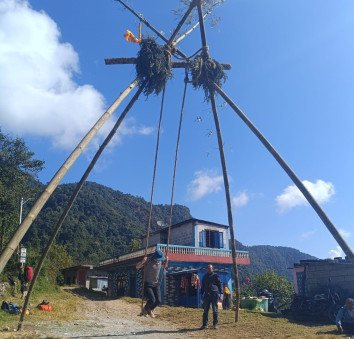
Bamboo swings (Ping). Tall bamboo swings appear in open fields and villages throughout the festival, a tradition especially loved by children, and a genuine piece of Dashain's atmosphere if you're travelling through rural areas.
Kite flying. Kites fill the sky during Dashain, traditionally understood as a way of signalling to the rain god that the monsoon can now end.
Kumari and Ganesh Puja. The living goddess Kumari and Lord Ganesh, remover of obstacles, are both worshipped during the festival period, reflecting the layered religious traditions that sit alongside the Durga narrative.
Why Dashain Matters So Much in Nepal
Dashain's significance goes beyond its religious origin. It's the point in the year when extended families reunite, when cultural traditions are actively passed down rather than just talked about, and when the whole country, regardless of caste, ethnicity or region, participates in some version of the same celebration. Schools and offices close, roads fill with people heading home, and for two weeks the country runs on a different rhythm entirely.
Dashain and Travel: Is It a Good Time to Visit Nepal?
Dashain falls right in the middle of Nepal's best trekking season. By mid-October the monsoon has cleared, skies are at their clearest, and trails are dry, conditions line up well with the festival period. If you're planning a trek or tour around this time, it's worth booking early: domestic flights, buses and popular teahouses get busier than usual as Nepalis travel home for the holiday.
Travelling during Dashain also means witnessing the country at its most culturally alive, family gatherings, market crowds, kite-filled skies and swings in every village you pass through, rather than just the physical landscape.
Frequently Asked Questions
When is Dashain in 2026? Dashain 2026 runs from October 11 (Ghatasthapana) to October 25 (Kojagrat Purnima), with the main Tika day on October 21.
How many days is Dashain celebrated? 15 days in total, though the most significant days are the 1st, 7th, 8th, 9th, 10th and 15th.
What is Tika and Jamara? Tika is a mixture of rice, yogurt and vermilion applied to the forehead by elders as a blessing. Jamara is the yellow barley grass sown on Ghatasthapana and given alongside the Tika on Bijaya Dashami.
What is the significance of Dashain? It marks the victory of good over evil, specifically the goddess Durga's defeat of the demon Mahishasura, and serves as Nepal's primary occasion for family reunion and cultural continuity.
Is Dashain a good time to travel or trek in Nepal? Yes. It falls within Nepal's clearest, driest trekking season (October to November), though transport and accommodation get busier as Nepalis travel home, book ahead if your trip overlaps with the festival.
Do offices and businesses close during Dashain? Government and many private offices typically close from around Phulpati through the days following Tika. If you're relying on official services during this window, plan around the closures in advance.
Is Dashain celebrated only by Hindus? It's primarily a Hindu festival, but in practice it's observed and celebrated across communities and backgrounds in Nepal, making it one of the country's most widely shared holidays regardless of individual religious practice.
Plan your next adventure
Ready to turn this inspiration into a real Nepal trip?
Talk with our trekking specialists for a tailored itinerary, departure dates, and the best route for your fitness level and travel style.