
Introduction - The Last Great Wilderness Circuit of Nepal
There are treks, and then there is the Manaslu Circuit.
While the Annapurna Circuit draws tens of thousands of trekkers each season and Everest Base Camp has become one of the world's most-photographed pilgrimages, the Manaslu Circuit remains something rarer and more precious — a raw, remote, and profoundly humbling journey around the world's eighth-highest mountain that demands genuine effort and rewards it with an experience unlike anything else on the planet.
At Himalaya Heart, we have been guiding trekkers through this extraordinary landscape for years. We have watched first-timers dissolve into tears at the top of Larkya La Pass. We have seen seasoned trekkers from Patagonia and the Dolomites go quiet with awe on the upper Budhi Gandaki trail. And we have watched every kind of traveller — young and old, fast and slow — return from the Manaslu Circuit transformed in some quiet, essential way.
This guide is written specifically for those planning the Manaslu Circuit Trek in May - one of the finest months to attempt this journey, though not without its unique character, challenges, and rewards.
May is spring in the Himalayas. The rhododendrons are finishing their bloom in the lower valleys. The mornings are sharp and crystalline. The high passes are clearing of winter snow. And the trail — still far less crowded than its famous rivals — offers a solitude and wildness that is becoming genuinely rare in the trekking world.
Let us take you through everything you need to know.
Why Choose the Manaslu Circuit Trek?
The Manaslu Circuit is a complete circumnavigation of Mount Manaslu (8,163m), following the ancient trade route used by Tibetan merchants for centuries. The trail traces the Budhi Gandaki River north from the lowland foothills of Gorkha district, climbs steadily through dense forest, terraced farmland, and dramatic gorges, ascends into the high alpine plateau of the Nubri and Tsum valleys, crosses the Larkya La Pass at 5,160 metres, and descends spectacularly into the Marsyangdi Valley before joining the Annapurna Circuit at Dharapani.
It is, in every sense, a complete Himalayan experience — combining the cultural richness of a trans-Himalayan journey, the physical challenge of a high-altitude crossing, and the natural diversity of a trek that moves from subtropical forest at 700 metres to glacial moraine at over 5,000 metres within a single journey.
Why the Manaslu Circuit stands apart:
The circuit requires a Restricted Area Permit — a deliberate government policy to limit trekker numbers and protect the cultural integrity of the communities along the route. This means the trail retains a quality of authentic encounter that the more famous routes have largely lost. You will share tea house evenings with Tibetan traders, sit in monasteries where the monks are genuinely surprised to see you, and walk for hours on trails where the only sounds are the river, the wind, and the occasional bell of a yak caravan.
It is difficult. It is remote. It is, without question, among the most rewarding experiences available to the modern trekker.
Manaslu Circuit Trek in May — What to Expect
The Case for May
May occupies an interesting position in the Himalayan trekking calendar. It sits in the final weeks of the spring season — after the peak rush of March and April, and before the monsoon arrives in earnest around mid-June. For trekkers considering the Manaslu Circuit, May offers several compelling advantages.
The skies in early May are still predominantly clear, particularly above 3,500 metres where monsoon cloud has not yet penetrated. The Larkya La Pass — the emotional and physical climax of the circuit — is fully passable by early May, having shed the worst of its winter snowpack. The trail-side vegetation is at its lushest and most vivid: the combination of late spring wildflowers, the last marigold-orange rhododendron blooms at 3,000–3,500 metres, and the brilliant green of new growth in the lower valleys gives the entire route a colour and vitality that the drier autumn season cannot match.
Trekker numbers in May are noticeably lower than March and April. The tea houses are open, the trails are maintained, but there is breathing room — both literally and figuratively.
The Honest Challenges of May
May also brings the approach of the monsoon, and it would be dishonest not to acknowledge this. Afternoon cloud build-up is common from early May onwards, and rain showers in the afternoons and evenings become more frequent as the month progresses. The lower sections of the trail — below Deng village — can become muddy and slippery after rain.
Visibility for the highest mountain views (particularly Manaslu's north face above Samagaon) is best in the early morning and tends to deteriorate by midday. This is simply the May reality, and experienced Himalaya Heart guides plan the day's objectives accordingly — beginning the most scenic sections at dawn wherever possible.
Leeches are present below 2,500 metres in May, particularly after rain. They are more an inconvenience than a danger, and a simple application of lemon juice or table salt solves them quickly. Good gaiters and insect-repellent socks are a worthwhile precaution.
The honest summary: May is an excellent month for the Manaslu Circuit for experienced trekkers who accept variable afternoon weather, pack appropriately for both warm valley days and cold high-altitude nights, and embrace the slightly wilder, more atmospheric quality that the shoulder season brings. It is arguably the most rewarding month for those who value solitude, lushness, and a sense of genuine adventure.
The Manaslu Circuit Trek Route — Day by Day
Days 1–2: Kathmandu to Soti Khola (710m)
Your Manaslu Circuit adventure begins with a drive from Kathmandu to Arughat — approximately seven to eight hours on roads that improve significantly year on year, though the final stretch remains an exercise in Himalayan optimism. From Arughat, a short additional drive or a half-day walk brings you to Soti Khola, the official trailhead.
The drive itself is part of the experience: the landscape shifts from the urban press of the Kathmandu Valley through rolling hills to the dramatic entry into the Gorkha foothills. Himalaya Heart handles all private transport, permits (Restricted Area Permit + Manaslu Conservation Area Permit), and accommodation on this first section so that your focus is entirely on arrival, acclimatisation, and anticipation.
Days 3–4: Soti Khola to Jagat (1,340m)
The first two days of walking introduce you to the Budhi Gandaki valley in its lower, subtropical incarnation. The trail follows the river through dense jungle, crosses multiple suspension bridges, passes through small Gurung and Magar villages, and offers your first taste of the distinctive Manaslu trail culture — local porters carrying improbable loads, children in school uniforms waving from doorways, and the river itself, a roaring, jade-green constant companion.
May vegetation here is extraordinary: the jungle is in full tropical exuberance, wild orchids cling to the rock faces above the trail, and the morning air smells of earth and flowering trees. This is also prime territory for birds, and May sees several migratory species still passing through — a particular delight for birdwatchers.
Jagat marks the entry into the restricted area and is where permits are formally checked. The stone village has good tea house accommodation and, in May, a pleasantly uncrowded atmosphere.
Days 5–7: Jagat to Deng to Namrung (2,630m)
The middle section of the lower circuit is where the Budhi Gandaki gorge becomes one of the most dramatic landscapes on the trek. The river has carved a canyon of extraordinary depth and colour — black metamorphic rock, white rushing water, and the near-vertical trail carved into the cliff face above. Suspension bridges criss-cross the gorge repeatedly, some of them long enough to sway disconcertingly in the afternoon breeze.
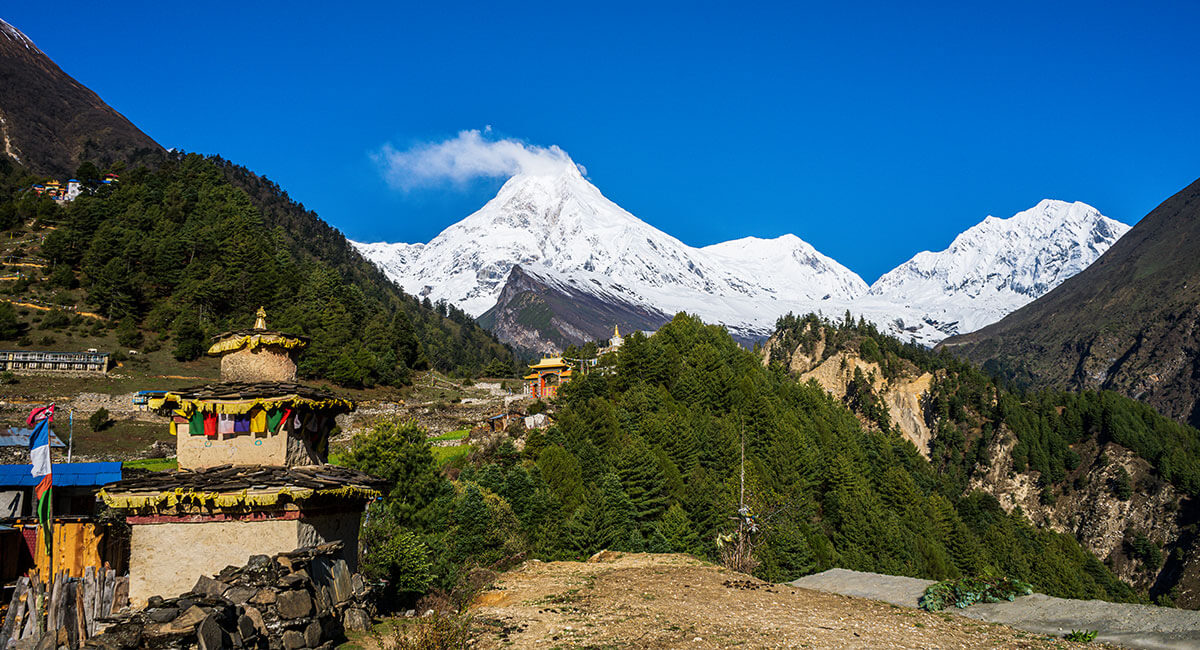
Namrung, at 2,630 metres, marks a shift in cultural character. You begin to see Tibetan-influenced architecture — prayer flags, mani walls, and chortens — and the people of the upper valley have distinctly Tibetan features and customs. The monastery above Namrung offers one of the first genuinely high-altitude viewpoints of the trek, with Manaslu beginning to appear in fragments above the ridgeline ahead.
Days 8–9: Namrung to Samagaon (3,530m) via Lho Village
Lho Village, sitting at 3,180 metres with an unobstructed north-facing view of Manaslu, is the moment on the trek that stops most trekkers cold. The mountain fills the entire northern skyline — massive, white, impossibly high — with the intricate ice of its upper faces clearly visible in the morning clarity. The village gompa, one of the oldest in the region, sits on a promontory above the valley in a position that seems almost deliberately theatrical.
Samagaon, a larger village at 3,530 metres, is the primary acclimatisation base for the Larkya La crossing. Himalaya Heart schedules a rest and acclimatisation day here — not merely as a physical necessity but because Samagaon and its immediate surroundings are genuinely worth a full day of exploration. The Manaslu base camp day hike (reaching approximately 4,800 metres) is one of the finest acclimatisation walks on any circuit trek in Nepal, and the Birendra Lake hike through glacial moraine to a stunning turquoise lake takes only three hours round trip.
Day 10: Samagaon to Samdo (3,860m)
A relatively short but altitude-significant day, walking north into a wide, open valley that feels increasingly Tibetan in character — the vegetation thins to high alpine scrub, yak-hair tents appear on the hillsides, and the sky seems to deepen in colour as the air thins. Samdo is the highest permanent settlement on the circuit, a small cluster of stone houses inhabited by families who spend their summers here and winters in the lower valleys.
The border with Tibet is visible from Samdo — a reminder that this region was historically an integral part of the trans-Himalayan trade network, and that the culture of the upper Manaslu valley is as much Tibetan as Nepali.
Day 11: Samdo — Acclimatisation Day
A second acclimatisation day at Samdo is not optional for responsible trekking — it is essential. Larkya La Pass at 5,160 metres is a serious high-altitude objective, and the altitude gain between Kathmandu (1,400m) and the pass summit demands respect and adequate preparation.
The standard acclimatisation walk from Samdo ascends to the old Nyi La Pass viewpoint at approximately 4,800 metres — a rewarding four-hour round trip that simultaneously prepares your body for the following day's challenge and offers sweeping views north towards Tibet and west towards the Larkya Glacier. It is a day worth taking seriously.
Day 12: Samdo to Larkya La Pass (5,160m) to Bimthang (3,720m)
This is the day. Everything on the Manaslu Circuit builds to this crossing, and it delivers completely.
The departure is pre-dawn — typically 4am–5am — to take advantage of the stable morning conditions and ensure arrival at the summit before afternoon cloud and wind build. The first two hours of ascent in the darkness, by headlamp, with only the sound of your own breathing and the crunch of frost under boot, is one of those rare trekking experiences that requires no embellishment.
As dawn breaks over the eastern ridgeline, the scale of what surrounds you becomes clear: the Larkya Glacier, Manaslu's southwest face, the Annapurna massif beginning to appear to the south, and the extraordinary Himalayan silence — broken only by the whistle of wind across the snowfield.
The summit of Larkya La is marked by prayer flags in various states of jubilant tatters. The descent to Bimthang on the western side is long — nearly 1,500 metres of elevation loss over 5–6 hours — and the knees will know about it the following morning. But Bimthang, a broad glacial valley ringed by peaks and dotted with yak herds, is one of the most beautiful campsites in the Himalaya, and the sense of achievement on arrival is total.
In May, the Larkya La summit area may still hold patchy snow on the upper approach, and Himalaya Heart guides carry crampons and ice axes for this section as standard equipment. The crossing is well within the capability of fit, acclimatised trekkers with competent guiding.
Days 13–14: Bimthang to Dharapani (1,860m) — Descent to Civilisation
The final two days descend through the Marsyangdi Valley, moving from the otherworldly high-altitude landscape of the upper circuit into the comparative warmth and greenery of the middle hills. The Annapurna massif — seen now from the east rather than the south — presents a completely different and equally spectacular profile.
Dharapani marks the junction with the Annapurna Circuit trail and the return to motorable roads. A bus or jeep from Dharapani to Besisahar and onward to Kathmandu completes the circuit — a final journey of approximately six to seven hours during which the entire arc of the trek can be replayed in memory against the changing landscape outside the window.
Permits Required for the Manaslu Circuit Trek
The Manaslu Circuit requires two specific permits in addition to standard national park documentation.
The Manaslu Restricted Area Permit (RAP) is the primary permit controlling trekker access to the upper circuit. It is issued only to trekkers accompanied by a licensed guide — solo trekking without a guide is strictly prohibited in the restricted area. The permit costs USD 100 per person for the first seven days and USD 15 for each additional day in September, October, and November; in all other months (including May) the cost is USD 75 per person for the first seven days and USD 10 per additional day, making May financially advantageous as well as logistically.
The Manaslu Conservation Area Permit (MCAP) costs NPR 3,000 (approximately USD 22) and covers the entire conservation area surrounding the Manaslu massif.
Himalaya Heart handles all permit applications on behalf of our trekkers, including the required minimum two-person group compliance and the mandatory licensed guide provision. You do not need to navigate Nepal's permit bureaucracy yourself — we manage every document from Kathmandu arrival to trailhead departure.
Physical Fitness and Training for the Manaslu Circuit
The Manaslu Circuit Trek is classified as a challenging trek — not because any single day is technically extreme, but because the cumulative demands of 14–16 days of sustained high-altitude walking, the altitude of the Larkya La crossing, and the remoteness of the route (emergency evacuation options are limited above Samagaon) require genuine physical preparation.
Himalaya Heart recommends the following minimum fitness preparation for trekkers planning the circuit in May:
12 weeks before departure: Begin regular cardiovascular training — hiking, cycling, swimming, or running — with a minimum of four sessions per week at moderate intensity. Prioritise uphill walking with a loaded pack if at all possible.
8 weeks before departure: Introduce weekend-long hikes of 5–7 hours with 800–1,000 metres of elevation gain, carrying a 12–15kg pack. This replicates the physical demand of a typical circuit day more accurately than any gym session.
4 weeks before departure: Taper intensity slightly while maintaining frequency. Focus on foot care — break in your trekking boots thoroughly to prevent the blisters that claim many trekkers on long-distance routes. Practice your blister management routine.
General strength guidance: Strong quadriceps and glutes are your most valuable asset on this trek, particularly on the long descent from Larkya La. Include squats, lunges, step-ups, and calf raises in your training from week one.
You do not need to be a marathon runner or a competitive mountaineer. You need to be systematically prepared, honest about your current fitness level, and willing to commit to the training schedule. Himalaya Heart can provide personalised fitness guidance as part of our pre-trek consultation for all booked trekkers.
What to Pack for Manaslu in May
May's weather range on the Manaslu Circuit spans tropical humidity at 700 metres to well below freezing at 5,160 metres — sometimes within a single day near the Larkya La crossing. Your packing list must account for this extraordinary range.
Layering system (non-negotiable): A moisture-wicking base layer, a mid-weight fleece or down sweater, and a waterproof-breathable shell jacket form your core system. In May, a lightweight down jacket for the high sections (above 4,000m) is essential — not optional.
Footwear: Waterproof trekking boots with ankle support and a Vibram sole, broken in over at least 100 kilometres of pre-trek walking. Trail runners are appropriate only for trekkers with extensive high-altitude experience. Bring gaiters for the muddy lower sections and potential snow on the pass.
Sleeping: Even in May, nights above 3,500 metres drop below zero. A sleeping bag rated to at least -10°C is recommended for the Samdo and Bimthang sections. Tea house blankets are available but are not reliably warm or clean.
Sun and altitude protection: UV intensity at 5,000 metres is severe. Glacier sunglasses with UV400 or darker rating, high-SPF sunscreen, lip balm with SPF, and a wide-brimmed sun hat are all essential.
Trekking poles: Strongly recommended for the Larkya La descent and for stability on the muddy trail sections in the lower valley. Adjustable poles that shorten for ascent and lengthen for descent are ideal.
Medications: Diamox (acetazolamide) for altitude sickness prevention — discuss with your physician before travel. Ibuprofen for altitude headaches. Oral rehydration salts. Water purification tablets as backup to the primary filter. Anti-diarrhoeal medication. Blister treatment kit.
Himalaya Heart provides a full equipment checklist to all booked trekkers, along with access to our gear advisory service for those who need guidance on specific items or brands.
Tea House Accommodation on the Manaslu Circuit
The Manaslu Circuit tea house infrastructure has improved significantly over the past decade, though it remains more basic than the Everest or Annapurna routes — which is precisely part of its appeal.
In the lower sections (Soti Khola to Jagat), tea houses offer simple but adequate twin-bedded rooms with shared bathrooms, hot showers (usually solar or bucket-heated), and a reliable menu of dal bhat, noodle soup, fried rice, and momos. Wi-Fi is available in Jagat and a few other lower-valley locations but becomes unreliable above Deng and non-existent above Namrung.
In the middle and upper sections (Namrung to Samdo), accommodation is more spartan — stone-walled rooms with thin mattresses and heavy yak-wool blankets. Heating is provided by a central wood or yak-dung stove in the common room. These conditions are not a hardship; they are part of the experience of walking a route that connects directly to centuries of Himalayan trade and travel.
Himalaya Heart pre-books accommodation throughout the circuit for all our groups, ensuring that the best available rooms are secured — a meaningful advantage in the few genuinely limited tea house locations. We also carry emergency sleeping equipment for all trekkers regardless of tea house quality.
Manaslu Circuit Trek Cost and What Himalaya Heart Includes
The fully guided Manaslu Circuit Trek with Himalaya Heart is priced between USD 1,600 and USD 2,200 per person depending on group size, accommodation preferences, and specific itinerary length.
Included in all Himalaya Heart Manaslu packages:
All Kathmandu accommodation (typically two nights before and one night after the trek), all airport and trailhead transfers, Restricted Area Permit (RAP) and MCAP permit fees, a licensed and experienced lead guide throughout the entire circuit, one porter per two trekkers carrying up to 25kg of group equipment, all tea house accommodation on the trail, all meals from the first trail breakfast to the last trail dinner, emergency oxygen cylinder carried by guides, first aid kit, and comprehensive pre-departure briefing in Kathmandu.
Not included: International flights, Nepal visa, travel insurance (mandatory for all Himalaya Heart clients), personal trekking equipment, tips for guides and porters, personal spending, and meals in Kathmandu.
Himalaya Heart also offers a fully private guided option for couples, families, and solo trekkers who prefer a completely personalised experience at a premium price point. Contact our Kathmandu office for a custom quote.
Frequently Asked Questions — Manaslu Circuit Trek in May
Is the Larkya La Pass safe to cross in May?
Yes, the Larkya La Pass is fully passable in May for fit, acclimatised trekkers with an experienced guide. Early May conditions may involve patchy snow on the upper approach, but the pass is reliably open and Himalaya Heart carries crampons and ice axes as standard equipment for all May departures. The critical requirement is an early morning start — before 6am — to complete the crossing before afternoon cloud and wind arrive.
Do I need a guide for the Manaslu Circuit?
Yes — it is a legal requirement. The Manaslu Restricted Area Permit is only issued to trekkers accompanied by a licensed guide. Independent trekking without a guide is not permitted on the circuit. Beyond the legal requirement, the remoteness and navigational complexity of the route make a knowledgeable local guide genuinely essential for both safety and a richer cultural experience.
How many trekkers will I encounter in May?
May is a lower-traffic month on the Manaslu Circuit. You can expect to encounter other trekking groups at most tea houses, but the trail itself offers significant stretches of complete solitude. You will not experience the queues and crowds that affect Everest Base Camp or the Annapurna Circuit during peak season.
Is altitude sickness a significant concern?
Altitude sickness is a real risk above 3,000 metres for any trekker regardless of fitness level. Himalaya Heart's itinerary is designed with conservative acclimatisation days built in, and our guides are trained in recognising and responding to altitude sickness symptoms. We carry emergency oxygen and satellite communication equipment on all treks. The absolute key rule — to which Himalaya Heart holds firm regardless of pressure from trekkers to push forward — is never to ascend with symptoms. Descend immediately if symptoms persist.
What is the mobile connectivity like on the trail?
Nepal Telecom (NTC) SIM cards provide mobile data signal in most settlements up to Samagaon, though quality is variable. Above Samagaon and on the pass, there is no mobile signal. Himalaya Heart guides carry a Garmin inReach satellite communicator on all treks for emergency communication. Inform family members before departure that contact during the upper circuit days will be limited.
Why Trek the Manaslu Circuit with Himalaya Heart
Himalaya Heart was founded by Himalayan guides who believe that the best trekking experiences are built on genuine knowledge of the landscape, deep relationships with the mountain communities along the route, and an honest, client-first approach to safety and logistics.
Our Manaslu Circuit guides have collectively led hundreds of circuit completions. They know which tea houses prepare the best dal bhat above 4,000 metres. They know the monastery keeper in Lho who will open the inner sanctum for a small group of respectful visitors. They know when the weather pattern is trustworthy for a Larkya La crossing and when it is not — and they have the confidence and authority to delay a departure by twelve hours to get it right.
We are not the cheapest operator on the Manaslu Circuit. We are, in the judgement of the trekkers who have walked with us, the most thorough — and on a trek of this remoteness and ambition, thoroughness is the single quality that matters most.
Final Thoughts — Answer the Call of Manaslu
The Manaslu Circuit in May is not a polished, choreographed experience. It is a genuine Himalayan journey — variable, vivid, occasionally demanding, and ultimately transformative in the way that only truly wild places can be.
You will walk trails where the loudest sound is the Budhi Gandaki River carving its ancient path through rock that was once the floor of the Tethys Sea. You will stand at 5,160 metres in the early morning and feel, with absolute physical certainty, that you are standing on the spine of the world. You will sit across a fire from a Tibetan salt trader in Samdo and share tea and inadequate language and the perfectly sufficient warmth of human recognition.
And when you descend the final switchbacks to Dharapani, dust-covered and strong-legged and altered in some way you won't fully understand until later, you will already be wondering when you can come back.
That is the Manaslu Circuit. That is what May does to it.
Himalaya Heart is ready when you are.
To book the Manaslu Circuit Trek in May with Himalaya Heart, or to request a detailed itinerary, custom quote, or pre-trek consultation, contact our Kathmandu team at info@himalayaheart.com or visit www.himalayaheart.com. Our offices are open seven days a week throughout the trekking season.