
Last updated: August 15, 2026
Quick facts
Annapurna Base Camp Trek Cost & Itinerary 2026/27: duration is 14 Days, price starts from us$1,100 per person, difficulty is moderate.
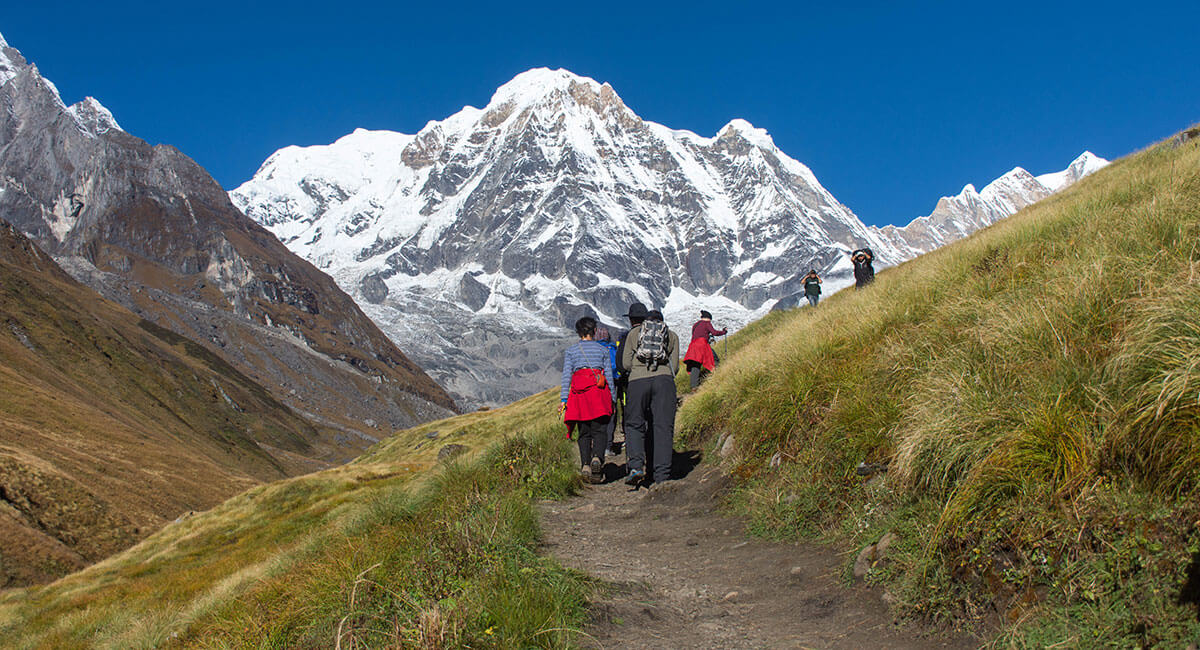
The Annapurna Base Camp Trek, also called the Annapurna Sanctuary Trek, reaches 4,130m at the base of Annapurna I. This page covers Himalaya Heart Treks' 14-day guided package via Ghorepani and Poon Hill, priced at $1,100 per person (reduced from $1,425), including hotel and teahouse accommodation, meals during the trek, a licensed guide, and porter support.
This trek runs in several different lengths depending on the starting point you choose, so here's exactly what this package includes, and how it compares to the shorter options.
| Trip starts / ends | Kathmandu (trekking starts near Nayapul, via Pokhara) |
| Duration | 14 days (this specific package, via Ghorepani/Poon Hill) |
| Trek difficulty | Moderate |
| Highest point | Annapurna Base Camp, 4,130m |
| Average trekking hours/day | 5–7 hours |
| Accommodation | Hotel in Kathmandu and Pokhara, teahouse lodges on the trail |
| Group size | 1+ (solo travelers welcome) |
| Best seasons | March–May (spring), September–November (autumn) |
| Price | $1,100/person (reduced from $1,425) |
The Annapurna Base Camp Trek can be done in several different lengths, and it's worth knowing which one you're looking at before comparing prices between operators, since a 7-day and a 14-day package covering the same base camp will naturally cost very differently.
This specific Himalaya Heart Treks package is the 14-day version, routed via Ghorepani and Poon Hill. Starting this way adds a proper sunrise viewpoint at Poon Hill and a longer approach through the Modi Khola valley, on top of the base camp trek itself.
Shorter alternatives exist if 14 days doesn't suit your schedule:
If you're set on the shorter version, ask us about our Short Annapurna Base Camp Trek package instead of assuming the price and itinerary on this page apply to it, they're two different products.
This 14-day guided package costs $1,100 per person, including all accommodation, meals during the trek, a licensed guide, porter support, and permits.
What's included:
What's not included:
Trekking to Annapurna Base Camp requires the Annapurna Conservation Area Permit (ACAP), which currently costs approximately NPR 3,000 (roughly $22–25 USD) for foreign nationals.
There's some genuine inconsistency in current reporting about the second permit historically required alongside ACAP, the TIMS card. Some sources report the independent TIMS card was discontinued in 2023 and that Annapurna checkpoints now check ACAP only; others report TIMS enforcement was reinstated on Annapurna routes more recently. Rather than guess, ask us to confirm exactly which permits we're currently processing for your specific departure date when you book, this is arranged for you either way as part of the package price.
A licensed guide is strongly recommended for this trek, both for safety on the steeper sections above Chhomrong and to help you navigate current permit and checkpoint requirements, which is exactly what's included in this package.
The Annapurna Base Camp Trek is rated moderate. It doesn't require technical climbing skill, but the trail genuinely goes up and down rather than climbing steadily, so total elevation gain over the trek is higher than the net altitude gain alone suggests. Most days involve 5–7 hours of walking.
Reasonable fitness and some hiking experience make the trek considerably more comfortable, but it's a realistic goal for a broader range of trekkers than the higher passes on Manaslu or Annapurna Circuit, since the maximum altitude here (4,130m) is meaningfully lower and altitude sickness risk correspondingly reduced, though not eliminated.
Spring (March–May) and autumn (September–November) offer the most reliable weather for the Annapurna Base Camp Trek.
December is workable but noticeably colder at higher elevation. January and February, along with the June–August monsoon months, are generally not recommended: winter for the cold, monsoon for rain, humidity, and reduced mountain visibility on the lower trail sections.
Both are base-camp treks beneath 8,000m peaks, but they differ meaningfully. Annapurna Base Camp tops out at 4,130m, well below Everest Base Camp's roughly 5,364m, which generally makes ABC the gentler, lower-altitude-sickness-risk option and a more realistic choice for first-time high-altitude trekkers. ABC also starts by road from Pokhara rather than a mountain flight into Lukla, removing one common point of weather-related delay from the trip. Everest Base Camp remains the more iconic destination and involves the higher, more demanding trek; Annapurna Base Camp is shorter to reach, generally less expensive, and still delivers a genuine high-mountain amphitheater at the end.
You'll stay in hotels in Kathmandu and Pokhara, then teahouse lodges throughout the trek, with shared bathrooms standard at higher elevations. Meals during the trek are included and typically feature dal bhat, noodle and soup dishes, and simple breakfast items, with hot showers and device charging generally available at teahouses for a small extra fee.
Clothing: comfortable trekking boots, warm and lightweight socks, layered warm clothing, sun hat, warm hat, evening sandals
Daily essentials: toiletries, basic medical kit, sunglasses, sunscreen, small towel, warm sleeping bag
Tools: headtorch, trekking poles, backpack with rain cover, water bottles, purification tablets
A Himalaya Heart Treks representative will welcome you at the airport and take you to the hotel where we will talk about the trip in more detail. This is an opportunity for you to ask any question you may have. The rest of the day is free to relax and explore
We explore three culturally diverse and visually stunning temples around Kathmandu We begin. High on a hilltop above Kathmandu at the magnificent Swayambutinath (“Monkey Temple”), used by both Hindus and Buddhists, and known for its many holy monkeys! Along the banks of the Bagmati River lies Pashupatinath, a temple devoted to Lord Shiva. It is the most important Hindu site in Nepal and pilgrims from all over the world come to show their faith.Away from the city centre is the peaceful and impressive Bodhnath Stupa. Every day thousands of people descend daily to show their devotion and respect.
Our whole team leaves for Pokhara today. We check out of the hotel for the drive to Pokhara, 200 kilometers west of Kathmandu. The drive is an excellent experience and a very scenic one with rolling foothills, mountain views and beside fast flowing rivers. When we reach Pokhara,this beautiful lake town always provides a welcoming gesture with stunning views of the mountains on a clear day. We check into our hotel and relax in one of the many restaurants around the lake perhaps some boating or swimming.
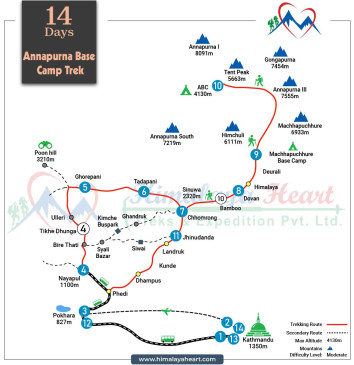
We leave our hotel and set out in the morning, taking a short drive to Nayapul before starting our trek. The trail at first descends sharply to a bridge crossing the Burundi Khola. After crossing the river we follow the banks of the Modi Kola before an ascent through bamboo forests to Tirkhadunga.
We start the day with a steep uphill along a forested trail and small settlements for around two hours before the trail eases out. On arrival at Ghorepani we are rewarded with some splendid mountain views. Overnight Lodge.
We are up before dawn to witness the spectacular sunrise over the Dhaulagiri and Annapurna Himals. As the sun emerges from behind the mountains the sky glows from red to pink in the first rays of the sun and the panorama is rated as one of the world’s great mountain vistas. The climb takes around 45 minutes and is well worth the effort. We trek down for breakfast, after breakfast we head east, following a forested ridge that again provides serious mountains views to cross a pass at 3,150m.
We pass through more forest and some tea houses before the descent becomes steeper down along a riveras we descend on stone steps through jungle to a few lodges in a clearing called Banthanti where we break for lunch. Descending further to a small stream, we cross a bridge and climb back up through forest to Tadapani our destination for today.Superb view of Annapurna South and the peak of Machhapuchhare.
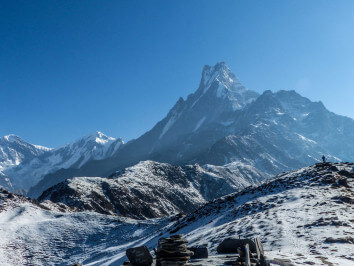
The trail descends steeply through the forest to the Kyumnu Khola, a tributary of the Modi Khola. From here we havea steep ascent through forest and a winding trail to Chhomrong. A Gurung village and the last permanent settlement in the valley. Beyond here the push toward Annapurna Base Camp begins. Chhomrong also has greta views again of Annapurna South and from this point onwards the twin-peaked mountain Machhapuchhare (‘fishtail’) which gives the mountain its name.
The trail from Chhomrong descends first on a steep stone staircase to cross the Chhomrong Khola, then climbs steeply on another stone staircase out of a side valley to Sinuwa and into the main Modi Khola Valley. From Sinuwa the trail descends on stone steps through dense jungle and up to Bamboo, a cluster of lodges in a forest clearing where we take lunch. The name is apt as the forest around us is full of bamboo thickets. These are cut extensively to make ‘dokos’ – the carrying baskets used by porters including ours. The Bamboo is also used to and make woven mats for floors and roofing. Undulating further through the bamboo forest we reach Dobhan another small clearing in the forest where there are several tea houses where we overnight.
A tough day today as we walk above 3,000m. The trail continues up through the forest, passing the lodges at Himalaya Hotel. From here the trail gets steeper and rockier as we climb up past Hinko Cave, where the first expeditions to the Base Camp used to camp. Crossing a ravine, the trail continues to climb steeply among boulders, leaving the trees behind us. We make our stop at Deurali for lunch.From Deurali the valley broadens out and the scenery becomes a lot wilder as we approach the gates of the sanctuary.
From Deurali there are two trails. The one on the left side of the valley is the main trail but especially in spring when there is a lot of snow it is not used and an alternative trail on the right side of the valley is used. Your Himalaya Heart Treks tour leader will decide which trail is best to use. Both trails finally meet for the last climb up between the giants of Hiunchuli and Machhapuchhare, to Machhapuchhare Base Camp (3,700m), where we spend the night. The views are out of this world with a fantastic panorama which includes Huinchuli, Annapurna 1, Annapurna 3, Gangapurna and Machhapuchhare.
In the early morning, we walk for around 2 hours up to Annapurna Base Camp (4,130m), surrounded by these snow-capped giants and some of the highest mountains in the world. Hiunchuli, Annapurna South, Annapurna Fang, Annapurna 1 and 3, Gangapurna and Machhapuchhare all encircle us Sunrise is truly magnificent casting subtle colours in this magnificent mountain arena. We spend some time in this special place before it is time to move and retrace our steps on a mostly downhill day as we leave the Sanctuary. We follow the same trail back to Machhapuchhare Base Camp and further down entering the forest, we descend slowly and carefully on a rocky trail to Himalaya.
A rollercoaster walk today with lots of ups and downs. We start with a climb up to Sinawa, then we descend to the river and climb back up the stone steps to Chomro. A final steep descent on stone steps brings us to Jhinnudanda. Close to Jhinnu danda, there are some hot springs time to relax up and soak any aching parts you may have.
The trail today undulates down the Modi River Valley. We follow the valley down to the road head at Siwai. If the road is in good condition, we will pick up our transport here (sometimes our vehicle cannot get to here) and drive back to Pokhara. Otherwise it is a pleasant trek along the river back to Nayapul. Where our jeep awaits for the drive back to our hotel in Pokhara (1 Hour)
Drive back to Kathmandu and spend time at leisure. You also have an option to fly back to Kathmandu at an additional cost.
It is time to say good bye for this time. We really hope that you had a nice time with us in Nepal. We will drive you to airport for the departure flight as per the schedule.
Trip duration: 14 Days
Pick a departure — your 14-day trip will be highlighted on the calendar.
This creates a private or flexible-date booking and does not join a fixed departure.
Green dates also have a fixed group departure. Calendar selections remain preferred-date bookings.
The Annapurna Base Camp Trek has a moderate level of difficulty, which means most reasonably fit trekkers can complete it without technical climbing skills. The trail climbs gradually, and Himalaya Heart Treks guides help you pace the journey comfortably.
Most travelers spend between seven and ten days on the Annapurna Base Camp Trek. The final duration depends on your walking pace and the itinerary you choose with Himalaya Heart Treks.
Spring and autumn offer the most reliable weather for the Annapurna Base Camp Trek. Clear skies, warm days, and calm mountain winds make these months ideal for the journey.
Yes, you need the TIMS card and the Annapurna Conservation Area Permit for the Annapurna Base Camp Trek. Himalaya Heart Treks arranges these documents for you before the trek begins.
Temperatures on the Annapurna Base Camp Trek vary with altitude and season. Nights can be chilly, especially above 3,000 meters, while days remain pleasantly warm during peak trekking months.
A good walking habit and general stamina are enough to enjoy the Annapurna Base Camp Trek. Regular hill walks before your trip make the journey gentler and more enjoyable.
Yes, beginners often choose the Annapurna Base Camp Trek because the trail is welcoming and well-paced. Himalaya Heart Treks team members stay close to first-time trekkers to ensure comfort and confidence.
Most nights are spent in local teahouses along the Annapurna Base Camp Trek. Rooms are clean and simple, with warm meals placed on long wooden tables that feel almost like home.
Altitude sickness is rare on the Annapurna Base Camp Trek compared to higher Himalayan regions, but it can still occur. Slow walking, proper hydration, and guidance from experienced Himalaya Heart Treks staff help reduce risk.
You’ll find warm Nepali meals like dal bhat, noodles, soups, and potato dishes throughout the Annapurna Base Camp Trek. The meals are hearty and comforting, just right for long days in the mountains.
Travel insurance covering high-altitude trekking is strongly recommended for the Annapurna Base Camp Trek. It gives peace of mind in case of unexpected weather or health issues.
Yes, many teahouses on the Annapurna Base Camp Trek provide Wi-Fi for a small fee. The connection may slow down as you climb higher.
Most teahouses offer charging facilities during the Annapurna Base Camp Trek. Carrying a power bank helps when electricity is limited.
Warm layers, a good down jacket, gloves, a comfortable backpack, trekking shoes, a refillable water bottle, and basic toiletries are the core essentials for the Annapurna Base Camp Trek.
Yes, trekking poles ease pressure on knees during the steady climbs and descents of the Annapurna Base Camp Trek.
With a trained guide from Himalaya Heart Treks, the Annapurna Base Camp Trek is safe and friendly for solo travelers. The trail is well-traveled, and locals are welcoming.
Annapurna Base Camp stands at 4,130 meters, a beautiful amphitheater of mountains that trekkers reach near the end of the Annapurna Base Camp Trek.
Many itineraries combine Poon Hill with the Annapurna Base Camp Trek. The sunrise over the Annapurna range from Poon Hill is breathtaking.
Safe drinking water is available at teahouses. Most trekkers carry purification tablets or reusable bottles during the Annapurna Base Camp Trek.
Hot showers are available at many teahouses on the Annapurna Base Camp Trek, often powered by gas or solar. A small fee may apply.
Children with trekking experience can join the Annapurna Base Camp Trek, especially with Himalayan Heart Treks guides who know how to set a gentle pace.
Many seniors complete the Annapurna Base Camp Trek each year. A relaxed pace and a clear itinerary make the journey manageable and rewarding.
If weather shifts suddenly, Himalaya Heart Treks guides adjust the walking plan to keep you safe. Mountain conditions change quickly, and local knowledge makes a difference.
The Annapurna Base Camp Trek becomes lively during spring and autumn. Winter and monsoon bring quieter trails.
Yes, winter trekking is possible if you enjoy crisp air and quiet trails. Snow adds beauty, but you’ll need warm layers and proper guidance.
While not mandatory, many trekkers hire guides and porters for the Annapurna Base Camp Trek. The journey becomes lighter and more enjoyable with expert support.
Most treks begin from Nayapul or Jhinu Danda, depending on your itinerary with Himalaya Heart Treks.
Yes, Himalaya Heart Treks designs flexible itineraries so every traveler can enjoy the Annapurna Base Camp Trek at a comfortable rhythm.
The Annapurna Base Camp Trek brings sweeping views of Annapurna I, Machhapuchhre, Hiunchuli, and snow-covered ridges rising sharply into the sky.
Costs vary by season, itinerary, and group size, but Himalaya Heart Treks offers both budget and comfortable packages for the Annapurna Base Camp Trek.
Trekkers usually walk five to seven hours a day during the Annapurna Base Camp Trek, with plenty of breaks along the way.
Regular hikes, leg exercises, and light cardio help your body adjust for the Annapurna Base Camp Trek. Start training a few weeks before traveling.
The Annapurna Base Camp Trek stays open most of the year, though monsoon can bring rain and occasional landslides.
Yes, trekkers can rent jackets, poles, and sleeping bags in Kathmandu and Pokhara before starting the Annapurna Base Camp Trek.
After Chhomrong, ATMs are rare. Carrying enough cash makes the Annapurna Base Camp Trek smoother.
A scenic drive from Pokhara brings you to the starting point of the Annapurna Base Camp Trek. Himalaya Heart Treks arranges private or shared transport.
If you need to stop due to health or fatigue, Himalaya Heart Treks arranges safe descent or evacuation based on your condition.
Tipping guides and porters is customary after the Annapurna Base Camp Trek. It’s a simple way to thank them for their support.
Yes, you can add Mardi Himal, Khopra Ridge, or Poon Hill to your Annapurna Base Camp Trek for a longer adventure.
Himalaya Heart Treks brings years of mountain experience, warm local guides, and thoughtful service to every Annapurna Base Camp Trek, creating a journey that feels both safe and personal.
The main seasons for trekking are the spring (Mar to May) and autumn (Sep to Nov) when you’ll have clear skies and superb mountain views. The winter (Dec to Feb) is also a great time to visit— these months offer a unique experience and fewer crowds but lower altitude treks are better at this time of year as its cold at night.
During the monsoon season (Jun to Aug), most of Nepal experiences heavy rain for a few hours each day. It’s humid, wet, and the trails in the lower regions (Ghorepani, Ghandruk, Langtang, etc) can be quite muddy. If you don’t mind the rain you’ll have the trails to yourself, the skies often clear up in the morning, and certain treks offer stone-paved trails that drain the rain and make for easy trekking. Also, certain regions, like Mustang and the upper reaches of Everest, lie in the rainshadow of the Himalaya and receive little rain but views however are still likely to be restricted.
Private tours are tailor-made itineraries built by us around your travel dates and personal interests, whereas group trips are pre-packaged and depart on specific dates. Group trips are also open for others to join, whereas private trips are just for you. You will find a list of fixed departure dates on our website.
For most nationalities, you can get your visa on arrival in Kathmandu. It takes around 45 minutes and is the most convenient way to get your visa you will need passport size photos. You can also apply for a visa in advance from a local Nepali consulate in your country if you’d like to have everything arranged in advance. Cost 15 Days – 25 USD / 30 Days – 40 USD / 90 Days – 100 USD
For mountain flights, you’re allowed 5 kg. carry-on to the plane and 10 kg. for checked-in luggage. For non-mountain sector flights, the check-in allowance increases to 20-25 kg.
If you’re mainly looking to experience Nepal’s cultural and natural highlights, you can have a great experience in 5-9 days, where you can visit two regions (likely Kathmandu and Pokhara perhaps go on Safari at Chitwan). If you intend to go trekking consider at least 10 days (more is better) to have enough time to reach higher altitudes and safely acclimatize if need be.To undertake one of the longer, classic treks in Nepal or to combine multiple regions and activities into one visit, think about 14-20 days and more if possible.
Himalaya Heart Treks organises complete tours, meaning everything is taken care of from the moment you arrive in Nepal to the moment you leave, including all of your accommodation in a three star Hotel. If you require better accommodation please let us know and we can arrange this and adjust the tour cost accordingly. Each of our tour pages shows clearly what is and what is not included in the tour price.
Personal expenses (tips, soft drinks, bar bills, laundry, telephone calls, donations, and extra snacks, etc) are not included in your tour price. When checking a particular trek page on our website we have clearly stated what is and what is not included. If you’re going trekking, the only things you’ll need to pay for out of pocket are wifi and battery charging (when available), extra meals outside of what’s included, alcohol, and soft drinks and perhaps hot showers.
Check the list of items necessary for trekking in Nepal.


See what travelers say about our service

Enjoy the popular trekking and tour packages in Nepal Himalayas. 2026.
Nepal , Annapurna Region Trekking
Annapurna Circuit TrekNepal , Annapurna Region Trekking
Mardi Himal Trek 2026Nepal , Annapurna Region Trekking
Upper Mustang Trek for 2026/2027Nepal , Annapurna Region Trekking
Ghorepani Poon Hill Trek 10 DaysNepal , Annapurna Region Trekking
Ghorepani Poonhill Trek and Jungle Safari 2026/2027Nepal , Annapurna Region Trekking
Special Annapurna Trekking 2026/2027



Copyright ® Himalaya Heart Treks & Expedition Pvt Ltd



Chris
Philippines
10th May, 2024
Best time for ever
Nov 2023 • Solo
One of the best experiences of my life. i have been annapurna base camp trek with himalaya heart trek my guide hari doing amazing job.
Thank you my brother Hari! You helped me connect with nature and fill my gallery with amazing photos!
Michel
United States
5th November, 2025
Annapurna Base Camp trek
I recently completed the Annapurna Base Camp (ABC) Trek with Himalaya Heart Trek, and it was an unforgettable experience from start to finish!
Our guide, Hari, was truly exceptional — friendly, caring, and very experienced. He always made sure we were safe, comfortable, and enjoying every part of the journey. Hari explained about the mountains, local culture, and nature along the way, and his cheerful attitude made the trek even more enjoyable.
The trail to Annapurna Base Camp was absolutely stunning — passing through beautiful rhododendron forests, charming Gurung villages, and alongside peaceful rivers and waterfalls. Reaching the base camp surrounded by the majestic peaks of Annapurna I, Machhapuchhre (Fishtail), and Hiunchuli was a dream come true.
Everything was perfectly arranged by Himalaya Heart Trek — from accommodation and food to transportation and support. I felt very well taken care of throughout the whole trip.
I highly recommend Himalaya Heart Trek and Guide Hari to anyone looking to trek in Nepal. Their professionalism, hospitality, and care made my Annapurna Base Camp trek one of the best adventures of my life!
John
United States
5th November, 2025
Great Holidays
I recently completed the Annapurna Base Camp (ABC) Trek with Himalaya Heart Trek, and it was an unforgettable experience from start to finish!
Our guide, Hari, was truly exceptional — friendly, caring, and very experienced. He always made sure we were safe, comfortable, and enjoying every part of the journey. Hari explained about the mountains, local culture, and nature along the way, and his cheerful attitude made the trek even more enjoyable.
The trail to Annapurna Base Camp was absolutely stunning — passing through beautiful rhododendron forests, charming Gurung villages, and alongside peaceful rivers and waterfalls. Reaching the base camp surrounded by the majestic peaks of Annapurna I, Machhapuchhre (Fishtail), and Hiunchuli was a dream come true.
Everything was perfectly arranged by Himalaya Heart Trek — from accommodation and food to transportation and support. I felt very well taken care of throughout the whole trip.
I highly recommend Himalaya Heart Trek and Guide Hari to anyone looking to trek in Nepal. Their professionalism, hospitality, and care made my Annapurna Base Camp trek one of the best adventures of my life!
Hussain
United Arab Emirates
5th November, 2025
Perfect organize
I recently completed the Annapurna Base Camp (ABC) Trek with Himalaya Heart Trek, and it was one of the most amazing experiences of my life!
Our guide, Krishna, was absolutely fantastic — friendly, knowledgeable, and very caring throughout the entire journey. He always made sure we were safe, comfortable, and enjoying every moment on the trail. Krishna shared lots of interesting information about the mountains, local lifestyle, and culture, which made the trek even more meaningful.
The trek to Annapurna Base Camp was truly breathtaking — walking through lush rhododendron forests, traditional Gurung villages, and alongside peaceful rivers and waterfalls. Reaching the base camp and standing beneath the towering peaks of Annapurna I, Machhapuchhre (Fishtail), and Hiunchuli was a moment I’ll never forget.
Everything was perfectly organized by Himalaya Heart Trek — from the accommodation and meals to transportation and support. The team was professional, warm, and always ready to help.
I highly recommend Himalaya Heart Trek and Guide Krishna to anyone planning to trek in Nepal. Their hospitality, organization, and care made my Annapurna Base Camp trek an unforgettable adventure!
Michel
Australia
9th December, 2025
Amazing
Nov 2025 • Solo
I did the Annapurna Base Camp trek with Himalaya Heart trek and everything was perfectly organized down to the smallest detail. The team was incredibly friendly, and the price–quality ratio was excellent. I came home richer in life experience, and I would highly recommend this company to anyone planning a trek in Nepal.
Rick
Australia
9th December, 2025
Life time experience
My Annapurna Base Camp Trek with Himalaya Heart Treks was absolutely unforgettable, and a huge part of that was thanks to our incredible guide, Hari. From the very first day, Hari made the whole journey feel safe, organized, and genuinely enjoyable. His knowledge of the mountains, local culture, and the best routes was impressive, and he always explained everything with patience and a warm smile.
Himalaya Heart Treks arranged everything perfectly—from comfortable teahouses to smooth transportation and well-planned walking days. I never had to worry about permits, logistics, or timing; Hari handled it all so professionally. What really stood out was how attentive he was to everyone’s pace and health. He constantly checked on us, encouraged us when the trail got tough, and shared amazing stories about the Himalayas that made the trek even more meaningful.
Reaching Annapurna Base Camp at sunrise was one of the most breathtaking moments of my life, and I’m grateful to have experienced it with such a dedicated company and guide. If you’re thinking about trekking in Nepal, I highly recommend Himalaya Heart Treks, and especially guide Hari. They made my ABC trek not just a trip, but a lifetime memory.”
If you want, I can write:
Rick
Australia
9th December, 2025
Life time experience
My Annapurna Base Camp Trek with Himalaya Heart Treks was absolutely unforgettable, and a huge part of that was thanks to our incredible guide, Hari. From the very first day, Hari made the whole journey feel safe, organized, and genuinely enjoyable. His knowledge of the mountains, local culture, and the best routes was impressive, and he always explained everything with patience and a warm smile.
Himalaya Heart Treks arranged everything perfectly—from comfortable teahouses to smooth transportation and well-planned walking days. I never had to worry about permits, logistics, or timing; Hari handled it all so professionally. What really stood out was how attentive he was to everyone’s pace and health. He constantly checked on us, encouraged us when the trail got tough, and shared amazing stories about the Himalayas that made the trek even more meaningful.
Reaching Annapurna Base Camp at sunrise was one of the most breathtaking moments of my life, and I’m grateful to have experienced it with such a dedicated company and guide. If you’re thinking about trekking in Nepal, I highly recommend Himalaya Heart Treks, and especially guide Hari. They made my ABC trek not just a trip, but a lifetime memory.”
If you want, I can write:
Rick
Australia
9th December, 2025
Life time experience
My Annapurna Base Camp Trek with Himalaya Heart Treks was absolutely unforgettable, and a huge part of that was thanks to our incredible guide, Hari. From the very first day, Hari made the whole journey feel safe, organized, and genuinely enjoyable. His knowledge of the mountains, local culture, and the best routes was impressive, and he always explained everything with patience and a warm smile.
Himalaya Heart Treks arranged everything perfectly—from comfortable teahouses to smooth transportation and well-planned walking days. I never had to worry about permits, logistics, or timing; Hari handled it all so professionally. What really stood out was how attentive he was to everyone’s pace and health. He constantly checked on us, encouraged us when the trail got tough, and shared amazing stories about the Himalayas that made the trek even more meaningful.
Reaching Annapurna Base Camp at sunrise was one of the most breathtaking moments of my life, and I’m grateful to have experienced it with such a dedicated company and guide. If you’re thinking about trekking in Nepal, I highly recommend Himalaya Heart Treks, and especially guide Hari. They made my ABC trek not just a trip, but a lifetime memory.”
If you want, I can write:
Andrea's
Spain
9th December, 2025
My best holiday
“My Annapurna Base Camp Trek with Himalaya Heart Treks was absolutely unforgettable, and a huge part of that was thanks to our incredible guide, Raj From the very first day, Hari made the whole journey feel safe, organized, and genuinely enjoyable. His knowledge of the mountains, local culture, and the best routes was impressive, and he always explained everything with patience and a warm smile.
Himalaya Heart Treks arranged everything perfectly—from comfortable teahouses to smooth transportation and well-planned walking days. I never had to worry about permits, logistics, or timing; Hari handled it all so professionally. What really stood out was how attentive he was to everyone’s pace and health. He constantly checked on us, encouraged us when the trail got tough, and shared amazing stories about the Himalayas that made the trek even more meaningful.
Reaching Annapurna Base Camp at sunrise was one of the most breathtaking moments of my life, and I’m grateful to have experienced it with such a dedicated company and guide. If you’re thinking about trekking in Nepal, I highly recommend Himalaya Heart Treks, and especially guide Raj . They made my ABC trek not just a trip, but a lifetime memory.”
If you want, I can write:
Sofia
Germany
9th December, 2025
Nepal trip
“My Annapurna Base Camp Trek with Himalaya Heart Treks was absolutely unforgettable, and a huge part of that was thanks to our incredible guide, Ram From the very first day, Hari made the whole journey feel safe, organized, and genuinely enjoyable. His knowledge of the mountains, local culture, and the best routes was impressive, and he always explained everything with patience and a warm smile.
Himalaya Heart Treks arranged everything perfectly—from comfortable teahouses to smooth transportation and well-planned walking days. I never had to worry about permits, logistics, or timing; Hari handled it all so professionally. What really stood out was how attentive he was to everyone’s pace and health. He constantly checked on us, encouraged us when the trail got tough, and shared amazing stories about the Himalayas that made the trek even more meaningful.
Reaching Annapurna Base Camp at sunrise was one of the most breathtaking moments of my life, and I’m grateful to have experienced it with such a dedicated company and guide. If you’re thinking about trekking in Nepal, I highly recommend Himalaya Heart Treks, and especially guide Ram . They made my ABC trek not just a trip, but a lifetime memory fo rme.
If you want, I can write: