
The Annapurna Base Camp trek is one of the most popular trekking destinations among trekkers and usually takes around 12-15 days, depending on the starting point and walking pace. It is visually very diverse, with Annapurna I, Machhapuchhre, and Annapurna South, giving trekkers the feeling that they are standing in the middle of the vast Himalayan mountains.
The Annapurna Base Camp trek altitude is 4,130 meters (13,550 ft) above sea level. The altitude is the main challenge of the trek; it is high enough to feel the effects of reduced oxygen.
With the gradual increase in elevation, trekkers can feel the thinning of the oxygen level. So, the Annapurna Base Camp Elevation is gained slowly rather than reaching directly to 4,130 meters. The trek starts in the lower hills, passing through places like Tikhedhungga, Ghorepani, Tadapani, Chhomrong, and Dovan before reaching Machhapuchhre Base Camp (MBC), at an altitude of 3,700 meters (12,139 ft). From here, the trail continues toward Annapurna Base Camp, which is the highest elevation in the entire trek. Reaching ABC, you will begin to experience the elevation gain as the trek progresses from Deurali towards Machhapuchhre Base Camp and to Annapurna Base Camp.
The trail is not technical, but as the ABC trek Altitude increases, the trekking becomes more challenging and physically demanding due to low oxygen and uneven terrain. As you trek from Dovan (2,600 m/8,530 ft) to MBC, the lower oxygen levels may start to affect breathing, energy, and walking pace, and some people may develop symptoms of altitude sickness. If trekkers experience symptoms such as headache, nausea, dizziness, unusual tiredness, loss of appetite, and trouble sleeping, they should avoid climbing to higher elevations or consult their trekking guide. So, the entire trek depends on ascent rate, rest time, hydration, walking pace, and, most importantly, individual response to altitude. Trekkers must keep a steady pace rather than walking without rest. You should pay attention to how your body reacts to higher altitudes.
Also, the trail involves long hours of walking, with many uphill sections and stone steps. Therefore, you should have good stamina and be comfortable walking long hours in hilly terrain. Comparatively, the ABC trek is shorter and lower than the EBC trek, but its long hours of walking and uphill sections make it more demanding.
This ABC elevation blog will help you understand where the trail climbs sharply, where altitude gain occurs, and where altitude starts to feel more noticeable. It will also discuss the possibility of altitude sickness and how to acclimate to the elevation. Overall, the guide will help you to prepare properly and know what to expect before heading into the higher section of the ABC trek.
What is the Exact Altitude of Annapurna Base Camp?
Annapurna Base Camp is located at an altitude of 4,130 meters (13,549 feet). It is commonly known as ABC and is located in the heart of the Annapurna Sanctuary. The base camp is at the foot of Annapurna I (8,091 m / 26,545 ft), and it is the highest location of the standard Annapurna Base Camp trek. At that altitude, the trek takes place in a high-altitude environment and offers stunning views of the Annapurna range.
The Annapurna Base Camp elevation, 4,130 meters, refers to the height of base camp in the Annapurna Sanctuary and not the summit of Annapurna I. These are two different elevations. While the ABC is a trekking destination with a maximum altitude of 4,130 m, Annapurna I rises to 8,091 m and requires technical mountaineering skills to reach the summit. Trekkers who undertake the Annapurna Base Camp trek also pass through Macchapuchre Base Camp (MBC), which sits at 3,700 meters (12,139 feet).
So, along the route from MBC to ABC, the elevation gain is around 430 meters. Although the distance is relatively short, the elevation gain becomes more noticeable as the trail is well over 3,700 meters. The surrounding landscape gives an alpine atmosphere with very low vegetation. Snow, glaciers, and the Himalayan mountains mark the region.
Also, many websites provide different figures for the altitude of Annapurna Base Camp. Some may report 4,130, while others may provide 4,131 or other measurements. This difference depends upon the mapping and survey source. For trekking information, 4,130 is the standard altitude for Annapurna Base Camp.
Annapurna Base Camp Trek Elevation Profile
The Annapurna Base Camp route depends upon the itinerary. However, the standard starting point for the trek is Pokhara. After reaching Pokhara by road or flight, trekkers need to trek through several villages to reach the ABC destination. On a 14-Day Annapurna Base Camp itinerary, the trek passes through villages like Ghorepani, Tadapani, Chhomrong, Dovan, Macchhapuchre Base Camp, Bamboo, Jhinu Danda, and Sinuwa. Here is a table for their elevation profile:
| Location | Altitude (Meters) | Altitude (Feet) | Notes |
|---|---|---|---|
| Kathmandu | 1,400 | 4,600 | Arrival point before the trek to Annapurna region. |
| Pokhara | 822 | 2,679 | Main gateway to the Annapurna region. |
| Nayapul | 1,070 | 3,510 | Traditional starting point for the Annapurna trekking route. |
| Tikhedunga | 1,540 | 5,052 | Low altitude overnight stop on the route towards Ghorepani. |
| Ghorepani | 2,875 | 9,432 | High altitude village and popular overnight stop often used for Poon Hill. |
| Tadapani | 2,630 | 8,628 | Scenic Gurung settlement. |
| Chhomrong | 2,225 | 7,299 | Major village and important trail junction before entering the Annapurna Sanctuary. |
| Dovan | 2,505 | 8,218 | Riverside settlement on the Modi Khola River. |
| Machhapuchhre Base Camp | 3,700 | 12,139 | High altitude settlement and major stop before ABC. |
| Annapurna Base Camp | 4,130 | 13,549 | Highest destination on the standard ABC trek. |
| Bamboo | 2,310 | 7,578 | Forested settlement along the Modi Khola River. |
| Jhinu Danda | 1,750 | 5,741 | Lower elevation village known for its natural hot springs. |
Day by Day Elevation Gain on the Annapurna Base Camp Trek
The elevation during the Annapurna Base Camp increases gradually then decreases on the return journey. The table shows the elevation change along the itinerary starting and ending from Kathmandu. It highlights the most significant altitude gains and losses, helping trekkers understand the overall elevation progression.
| Itinerary | Trekking Route | Elevation | Net Elevation Change |
|---|---|---|---|
| Day 1 | Kathmandu Arrival | 1,400 m / 4,600 ft | — |
| Day 2 | Kathmandu Heritage Sightseeing | 1,400 m / 4,600 ft | 0 m |
| Day 3 | Drive to Pokhara | 822 m / 2,697 ft | -578 m |
| Day 4 | Drive Pokhara to Nayapul and trek to Tirkhedunga | 1,540 m / 5,052 ft | +718 m |
| Day 5 | Trek from Tikhedunga to Ghorepani | 2,875 m / 9,432 ft | +1,335 m |
| Day 6 | Trek from Ghorepani to Tadapani | 2,630 m / 8,628 ft | -245 m |
| Day 7 | Trek from Tadapani to Chhomrong | 2,225 m / 7,299 ft | -405 m |
| Day 8 | Trek from Chhomrong to Dovan | 2,505 m / 8,218 ft | +280 m |
| Day 9 | Trek from Dovan to Machhapuchhre Base Camp | 3,700 m / 12,139 ft | +1,195 m |
| Day 10 | Trek from MBC to Annapurna Base Camp and return to Bamboo | ABC: 4,130 m / 13,549 ft Bamboo: 2,310 m / 7,578 ft | +430 m to ABC; -1,820 m to Bamboo |
| Day 11 | Trek from Bamboo to Jhinu Danda | 1,750 m / 5,741 ft | -560 m |
| Day 12 | Trek from Jhinu Danda to Siwai and drive to Pokhara | Pokhara: 822 m / 2,697 ft | -928 m |
| Day 13 | Drive to Kathmandu | 1,400 m / 4,600 ft | +578 m |
| Day 14 | Departure | — | — |
Annapurna Base Camp Altitude Compared to Everest Base Camp Trek
Both Annapurna Base Camp and Everest Base Camp are considered classic treks in Nepal. However, the highest altitude in Everest Base Camp is greater than that of Annapurna Base Camp. On the Everest Base Camp trek, trekkers not only reach the base camp altitude of 5,364 meters but also continue to Kalapatthar, at 5,545 meters. With the ABC trek at 4,130 meters, the altitude difference is about 1,415 meters, which is significant.
The gap makes a real difference in the experience and how your body responds during the trek. At Annapurna Base Camp, the oxygen level is around 60%, whereas on the EBC trek, it drops to 50%. As a result, the risk of altitude sickness is greater during the Everest trekking route as compared to the Annapurna. Trekkers need to dedicate two acclimatization days in the Everest region, preferably in Namche and Dingboche. In contrast, the Annapurna Base Camp follows a more gradual ascent with fewer stops in the high-altitude region.
So, due to the altitude difference, the Annapurna Base Camp trek is better suited to high-altitude trekkers with limited time. It can deliver the same level of mountain scenery and Himalayan landscape experience as compared to Everest Base Camp. Due to the altitude, the trek is more manageable and safer.
| Point | Annapurna Base Camp Trek | Everest Base Camp Trek |
|---|---|---|
| Highest Point | 4,130 m (13,550 ft) | 5,545 m (18,192 ft) at Kala Patthar |
| Base Camp Altitude | 4,130 m (13,550 ft) | 5,364 m (17,598 ft) |
| Typical Overnight Max | 3,700 m | 5,164 m (Gorak Shep) |
| Altitude Difference | — | Approx. 1,200–1,400 m higher than ABC |
| Acclimatization | No dedicated acclimatization day. Follows gradual ascent. | Two acclimatization days in Namche and Dingboche. |
| Oxygen Level (approx.) | Approx. 60% of sea level | Approx. 50% of sea level |
| Altitude Sickness Risk | Moderate | Higher |
Still, if you want to see the highest mountain in the world, then you can choose the Everest Base Camp trek. The trek is comparatively longer and more demanding. The decision largely depends on your preferences, fitness level, and time period. But if you want to go on a more manageable trek and have a lower risk of altitude sickness, then choose Annapurna Base Camp trek.
(Note: See Our Popular Everest Base Camp Trek packages in Everest Region Trekking)
How Does Annapurna Base Camp Altitude Compare to Other Famous Trek?
The altitude of Annapurna Base Camp is moderate. Compared to other high-altitude Himalayan treks, the ABC is a well-balanced middle ground. The table below shows a side-by-side comparison of the ABC altitude with other notable trekking routes, such as Poon Hill, Mardi, Gosaikunda, Langtang, Manaslu, and others.
| Trek | Highest Point | Difference from ABC | Altitude Category |
|---|---|---|---|
| Annapurna Base Camp | 4,130 m | — | Moderate |
| Poon Hill | 3,210 m | -920 m | Beginner |
| Mardi Himal | 4,500 m | +370 m | High |
| Gosaikunda Lake | 4,380 m | +250 m | High |
| Langtang (Kyanjin Ri / Tserko Ri) | 4,773-4,984 m | +643 to +854 m | Very High |
| Upper Mustang | 3,840-4,200 m | Similar / lower | Moderate |
| Manaslu Circuit (Larkya La) | 5,160 m | +1,030 m | Extreme |
| Kanchenjunga Base Camp | Approx. 5,140 m | +1,010 m | Extreme |
| Annapurna Circuit (Thorong La) | 5,416 m | +1,286 m | Extreme |
| Gokyo Ri | 5,357 m | +1,227 m | Extreme |
| Tilicho Lake | 4,919 m | +789 m | Very High |
The Poon Hill trek is lower and easier compared to the Annapurna Base Camp trek. However, Mardi Himal and Gosaikunda are slightly higher and only a few hundred meters above Annapurna. The extra elevation is noticeable, but the overall experience is still manageable.
But treks like Annapurna Circuit, Manaslu Circuit, and Kanchenjunga Base Camp are significantly higher than ABC. The routes are longer, which also poses the risk of altitude sickness and demands better physical fitness.
So at 4,130 meters, Annapurna is a sweet spot. Trekkers get the classic base camp experience while surrounded by 7,000 and 8,000-meter peaks. Sleeping in such altitudes is also more manageable than the routes that push above 5000 meters. The balance of altitude is one of the primary reasons for the popularity of Annapurna Base Camp.
Does Altitude Sickness Affect the Annapurna Base Camp Trek?
Yes, altitude sickness affects the Annapurna Base Camp Trek. The trek progresses well above 3000 meters, so there is a chance that trekkers might be affected by Acute Mountain Sickness (AMS). However, not all individuals get altitude sickness, as the condition varies from person to person.
The risk of altitude sickness increases at higher elevations along the trek, including at Machhapuchhre Base Camp and Annapurna Base Camp. Trekkers may experience symptoms such as headache, nausea, vomiting, dizziness, fatigue, difficulty breathing, and difficulty sleeping. There is a chance these symptoms can worsen and lead to complications of altitude sickness, including High-Altitude Pulmonary Edema (HAPE) and High-Altitude Cerebral Edema (HACE). These complications are life-threatening.
Also, physical fitness does not make trekkers immune to altitude sickness. If you are fit, you might want to walk fast, which may lead to rapid ascent. If such conditions prevail, then despite good physical fitness, you may be affected by altitude sickness. So the rate of ascent, time of acclimatization, previous trekking experience, and body response are some of the determining factors of AMS.
If conditions after the altitude-related problem do not improve, trekkers must descend immediately. Trekkers must also carry travel insurance if an emergency helicopter evacuation is required.
Annapurna Base Camp Acclimatization
A classic Annapurna Base Camp trek itinerary doesn’t include acclimatization days. As the trek is completed in a short period and mostly involves a slow walk from lower to higher elevations, dedicated acclimatization is not necessary. The slow transition passes through numerous villages, such as Chhomrong, Dovan, and Machhapuchhre Base Camp that allows the body to adjust to lower oxygen levels.
The most important elevation gain is on the Machhapuchre Base Camp to Annapurna Base Camp section. At this elevation, trekkers should ascend slowly at a natural pace and allow their bodies to rest. Trekkers should not walk as if it were a race, especially while approaching ABC.
If you want dedicated acclimatization, Himalayan Heart can customize the itinerary to include an acclimatization day. It may be useful for beginner trekkers; however, those with experience can do the trek with ease without any rest days included in the itinerary. The most important thing is to understand how the body responds to altitude and to monitor symptoms carefully. If symptoms appear, take time to rest and halt your ascent. Also, if the symptoms prevail for long days, follow immediate descent. Consult with your local guide and follow the instructions.
How Difficult is the Annapurna Base Camp Trek Because of Altitude?
Annapurna Base Camp is moderately challenging due to the increasing altitude as the trail rises from 1,540 meters to 4,130 meters at Annapurna Base Camp. The lower part is relatively easier to walk compared to the higher part of the ABC trek, as the trail mainly involves an uphill section. The higher part of the trek becomes more challenging as altitude increases and oxygen levels decrease, making it more physically demanding. As you go higher, walking and breathing become more difficult due to low oxygen levels. So, it is important to take regular rest breaks and maintain a steady walking pace rather than rushing.
- ABC sits at 4,130 meters, which is high enough to experience lower oxygen levels. At a higher altitude, even a little uphill climb feels harder.
- The trek starts in the lower part, which also has a lower altitude. Trekkers tend to gain significant elevation over several days, a pattern that becomes more noticeable in the upper part of the route.
- The risk of altitude sickness increases above 3,000 meters. Your strength and fitness do not prevent altitude sickness, so it is important to notice any symptoms your body shows.
- The trail from Doval to ABC is more challenging than the lower part. The trail climbs to a higher altitude, a colder region, lower oxygen levels, and a more open, uphill landscape.
- Temperatures become colder near the MBC and ABC, especially in the morning and at night. So, proper clothing and preparation are very important.
- Rushing or walking too quickly makes the trail harder. Instead, trekkers must walk steadily by taking regular rest breaks and staying hydrated.
- Proper acclimatization is essential to adapt your body to changing altitudes and avoid the risk of altitude sickness.
Overall, the ABC trek is not technical but moderately challenging due to its high altitude, long walking days, uphill terrain, and repeated climbs. Fit, strong trekkers can complete this trek with proper guidance and preparation. However, being fit does not guarantee that you will not experience altitude sickness. Trekkers must still consider the risk of altitude sickness.
How to Prepare for Annapurna Base Camp Altitude?
Trekkers do not need technical or mountaineering-level training, but arriving with good fitness is the major preparation that makes the trek easier and more comfortable. The preparation is mostly about fitness, steady pace, hydration, enough rest, and acclimatization. Trekkers must also follow or choose the correct itinerary with proper overnight stops, allowing enough time for their bodies to adjust.
- Build physical fitness: Trekkers must prepare several weeks before the trek with activities such as walking, hiking, cycling, and swimming. A light cardio workout targeting your legs and core is recommended to build strength, as the trail includes uphill climbs, descents, and stone steps. You do not require an intense workout routine, but regular, consistent exercise is useful.
- Ascend at a steady pace: Rushing or walking too quickly at a lower elevation is what you should avoid. Walking steadily at a consistent pace is very important, as it allows you to breathe comfortably throughout the trek. A steady pace also gives your body more time to respond to the increasing elevation.
- Stay hydrated: You must drink water throughout the trek rather than waiting until you feel very thirsty. Trekkers must drink about 4-6 liters of water. Carry a water bottle and refill where safe drinking water is available.
- Get enough rest: Your body needs time to recover after walking for several hours at a higher altitude. Trekkers must get enough sleep and take regular rest breaks while trekking. Proper rest becomes more valuable in higher altitude regions like MBC and ABC.
- Understand altitude sickness: You should know about altitude sickness before starting the trek. If you experience any symptoms, avoid climbing to higher altitudes and consult your trekking guide. More altitude illness can develop if symptoms are ignored.
- Choose the correct itinerary: Trekkers must choose a well-planned itinerary that includes sensible overnight stops along the route. It also gradually increases the sleeping elevation. You must choose an itinerary that gives you enough time to walk comfortably and spend an acclimatization day as the altitude increases.
Annapurna Base Camp Altitude Map
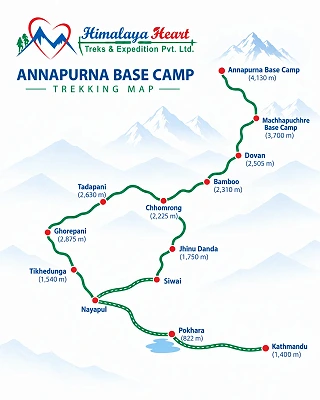
| Day 1 | Kathmandu Arrival | 1,400 m |
| Day 2 | Kathmandu Heritage Sightseeing | 1,400 m |
| Day 3 | Drive to Pokhara | 822 m |
| Day 4 | Drive Pokhara to Nayapul and trek to Tirkhedunga | 1,540 m |
| Day 5 | Trek from Tikhedunga to Ghorepani | 2,875 m |
| Day 6 | Trek from Ghorepani to Tadapani | 2,630 m |
| Day 7 | Trek from Tadapani to Chhomrong | 2,225 m |
| Day 8 | Trek from Chhomrong to Dovan | 2,505 m |
| Day 9 | Trek from Dovan to Machhapuchhre Base Camp | 3,700 m |
| Day 10 | Trek from MBC to Annapurna Base Camp and return to Bamboo | ABC: 4,130 m Bamboo: 2,310 m |
| Day 11 | Trek from Bamboo to Jhinu Danda | 1,750 m |
| Day 12 | Trek from Jhinu Danda to Siwai and drive to Pokhara | Pokhara: 822 m |
| Day 13 | Drive to Kathmandu | 1,400 m |
| Day 14 | Departure | — |
FAQs
What is the altitude of Annapurna Base Camp?
Annapurna Base Camp altitude is 4,130 meters or 13,550 ft above sea level. It is situated within the Annapurna Sanctuary in Nepal's Annapurna region.
What is the highest altitude during the Annapurna Base Camp trek?
4,130 meters, or 13,550 feet, is the highest altitude on the ABC trek, at Annapurna Base Camp itself.
Can beginners do the Annapurna Base Camp trek?
Yes, beginners can do the ABC trek by walking/hiking consistently, doing a simple cardio workout before the trek. This will help trekkers to gain strength and build stronger legs to walk uphill during the trek.
Is ABC higher or lower than Everest Base Camp?
Annapurna Base Camp is lower than Everest Base Camp. ABC is at 4,130 meters while EBC is at 5,364 meters. So the elevation difference is about 1,234 meters.
Is Annapurna Base Camp harder than Everest?
No, the Annapurna Base Camp trek is easier than the Everest Base Camp trek because of the shorter trail and lower altitude. But, ABC is also physically demanding because of long uphill trails, descents, and stone steps.
Why is Annapurna Base Camp so famous?
ABC is famous because it offers a close look at the world’s highest peaks on a shorter, easier trek than other major Himalayan routes. Trekkers can enjoy the beautiful view of Annapurna I, Annapurna South, Machhapuchhre, and Hiunchuli.
Which is better, the Annapurna Circuit or the base camp?
It depends on the trekker’s fitness, experience, and ability to adapt to the altitude. ABC is shorter than the Annapurna Circuit, which offers more varied landscapes and broader journeys around the Annapurna range.
How many days will it take to complete the Annapurna Base Camp trek?
The Annapurna Base Camp trek takes between 7 and 12 days to complete. However, depending on the itinerary and whether you start and end your trek in Kathmandu, the trek can take anywhere from 10 to 14 days.
How fit do you need to be for Annapurna Base Camp?
You should be physically fit and very comfortable in walking long uphills and descents. Regular hiking, walking, cycling, swimming, and cardio training would be helpful before the trek, making the journey much easier.
Conclusion
The ABC altitude of 4,130 meters may feel challenging, but it is still achievable for people with good strength, a steady pace, and proper preparation. The main thing is to avoid rushing, as a steady walking pace makes it easier to handle the higher altitude. ABC is at a lower elevation and shorter than EBC. But trekkers must consider altitude seriously in the upper section of the trek. You should plan your ABC adventure with a proper itinerary and guidance to enjoy the Himalayan views, changing scenery, and cultural experience. Join Himalayan Heart for your next Annapurna Base Camp adventure.